Fictional demonstration by Grey Dog Labs · not a real company

About this example
Project inquiry
  • Fictional company
  • Lancaster County, Pennsylvania
  • Since 1998
  • Mid-Atlantic and Northeast

End-of-line packaging, from flat blank to wrapped pallet.

Halvard builds and commissions the machines after your filler: case erecting, packing, sealing, checkweighing, print-and-apply labeling and stretch wrapping. Lines run 10 to 30 cases a minute for food, pharma and 3PL plants. 186 commissioned since 1998.

The HL-24 line Erect, pack, seal, weigh, label, wrap

Line rate 24 cases/min

HL-24 end-of-line strip, fictional Halvard demonstration Six stations in a row. Case erecting at 30 cases a minute, top-load packing at 24, sealing at 30, checkweighing at 40, print-and-apply labeling at 30 labels a minute, and turntable stretch wrapping at 45 loads an hour. A case travels from flat blank to wrapped pallet, and the line runs at 24 cases a minute. 01Erect30 cases/min250-blank magazine 02Pack24 cases/minSets the line rate 03Seal30 cases/min2 or 3 in tape 04Weigh40 cases/min±5 g, pusher reject 05Label30 labels/minEvery label scanned 06Wrap45 loads/hr250% pre-stretch HL-24 end-of-line strip, fictional Halvard demonstration Six stations in two rows: erect, pack and seal, then the line turns and runs back through weigh, label and wrap. The line runs at 24 cases a minute. 01Erect30/min 02Pack24/min 03Seal30/min 04Weigh40/min 05Label30/min 06Wrap45 loads/hr

Every station is rated above line rate, so the packer sets the pace. Palletizing sits between label and wrap: your palletizer, or one we specify.

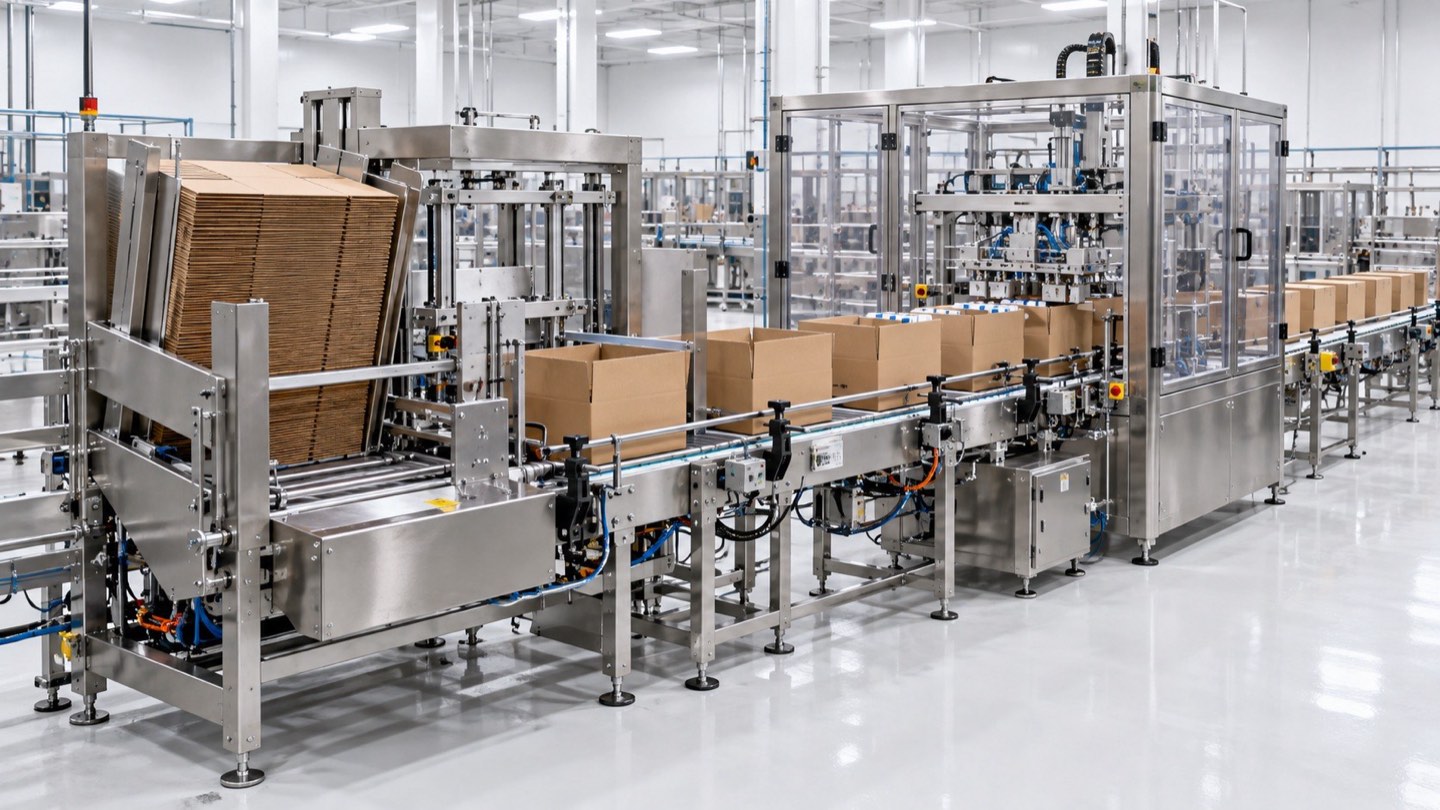
Case erecting and packing line: a magazine of flat corrugated blanks feeds a case erector, and open cases ride the conveyor into a guarded case packer (fictional company demonstration)
Line 4 · erect, pack and seal at 24 cases/minFrozen-food plant, central Pennsylvania. Illustrative project; Halvard is a fictional company.

A line runs at the speed of its slowest station.

We build and integrate the machines after your filler: case erectors, top-load packers, case sealers, checkweighers, print-and-apply labelers and stretch wrappers, plus the conveyor, accumulation and PLC controls between them. One shop in Lancaster County designs the line, runs your product through it at FAT, and services it for as long as it runs.

Describe your line
First line commissioned
1998
Lines commissioned
186
People, one shop
41
States served
9

01 · The HL-24 line

Six stations, one spec sheet.

Our standard 24 cases/min line, station by station. Every figure below is the rated figure we hold at FAT with your product and your cases.

01 Case erecting

Flat blank to square case, 30 a minute.

A vacuum pick pulls each blank from the magazine, squares it against a fixed backstop, folds the bottom flaps and tapes or glues them. Square matters: a case that leaves the erector out of square jams the packer two stations later.

Rate
Up to 30 cases/min
Case range
L 8–24 in · W 6–18 in · H 4–20 in, RSC
Magazine
250 blanks, reloads while running
Bottom seal
2 or 3 in tape, or hot melt
Changeover
4 min, handwheels with digital counters
Air
90 psi, 18 SCFM

02 Top-load packing

The station that sets the pace.

A servo gantry picks a full layer from the collator and places it in the open case. Bottles, pouches, cartons and trays each get their own end-of-arm tool, swapped by hand without tools.

Rate
24 cases/min at 12-count
Pick
Up to 24 units per cycle
Payload
25 kg per pick
Tool change
6 min, quick-release plate
Product
Bottles, pouches, cartons, trays
Guarding
Interlocked doors, light curtain at infeed

03 Case sealing

Flaps folded, taped, and square.

Top flaps fold on the move, side belts drive the case under the tape head, and the case leaves square for the checkweigher. Uniform tapers for single-size runs, random for mixed.

Rate
Up to 30 cases/min
Tape
2 or 3 in, top and bottom
Case height
4–20 in
Mode
Uniform, or random with auto-adjust
Tape change
45 s, no tools

04 Checkweighing

Every case weighed. Short ones don’t ship.

An in-motion checkweigher weighs each case against its target and pushes rejects into a locked bin. Weights post to your WMS or MES with the case barcode, so every short case has a record.

Rate
Up to 40 cases/min
Accuracy
±5 g (2σ) on cases to 25 kg
Capacity
30 kg
Reject
Pusher into a locked bin, with confirm sensor
Data
Per-case weight to WMS or MES

05 Print-and-apply

Printed, applied, read back.

A thermal-transfer print engine prints the case label from your WMS data, a tamp or tamp-blow applicator places it, and a scanner downstream grades the barcode before the case leaves the station.

Rate
Up to 30 labels/min
Print
300 dpi thermal transfer, 4 × 6 in
Placement
±1/16 in
Apply
Tamp, tamp-blow or corner-wrap
Verify
Every label scanned; fails go to the reject lane

06 Stretch wrapping

Wrapped tight, film counted.

A turntable wrapper with powered pre-stretch stretches film 250 percent before it touches the load, so each pallet uses less film and holds tighter on the trailer. Clamp-and-cut ends each cycle with nobody at the turntable.

Rate
Up to 45 loads/hr
Pre-stretch
250%, powered
Load
48 × 48 × 80 in, 4,000 lb
Film tail
Automatic clamp and cut
Options
Top sheet, load count to WMS

02 · Wrap and label

The last two stations decide what the dock sees.

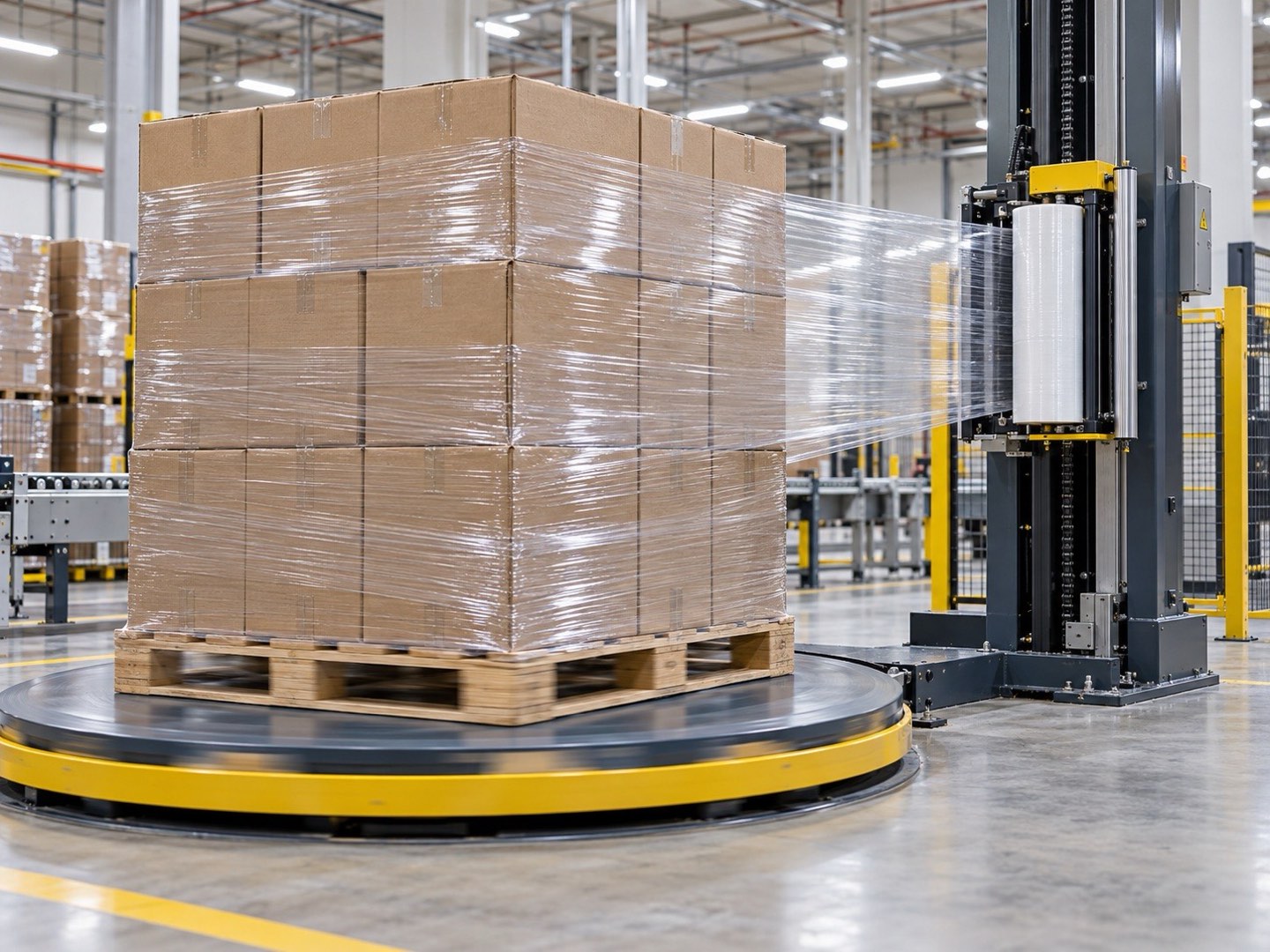
Turntable stretch wrapper with a powered pre-stretch film carriage on its mast, wrapping a pallet of corrugated cases (fictional company demonstration)
Station 06 · Wrap

Loads that arrive the way they left.

Pre-stretch does the work, not the operator. Film stretched 250 percent before it reaches the load grips harder and runs further per roll. The wrapper counts revolutions and film per load, so you can see when a pattern drifts.

  • 45 loads/hr on one turntable
  • Top and bottom wraps set per pallet pattern
  • Forklift-free outfeed on pallet conveyor
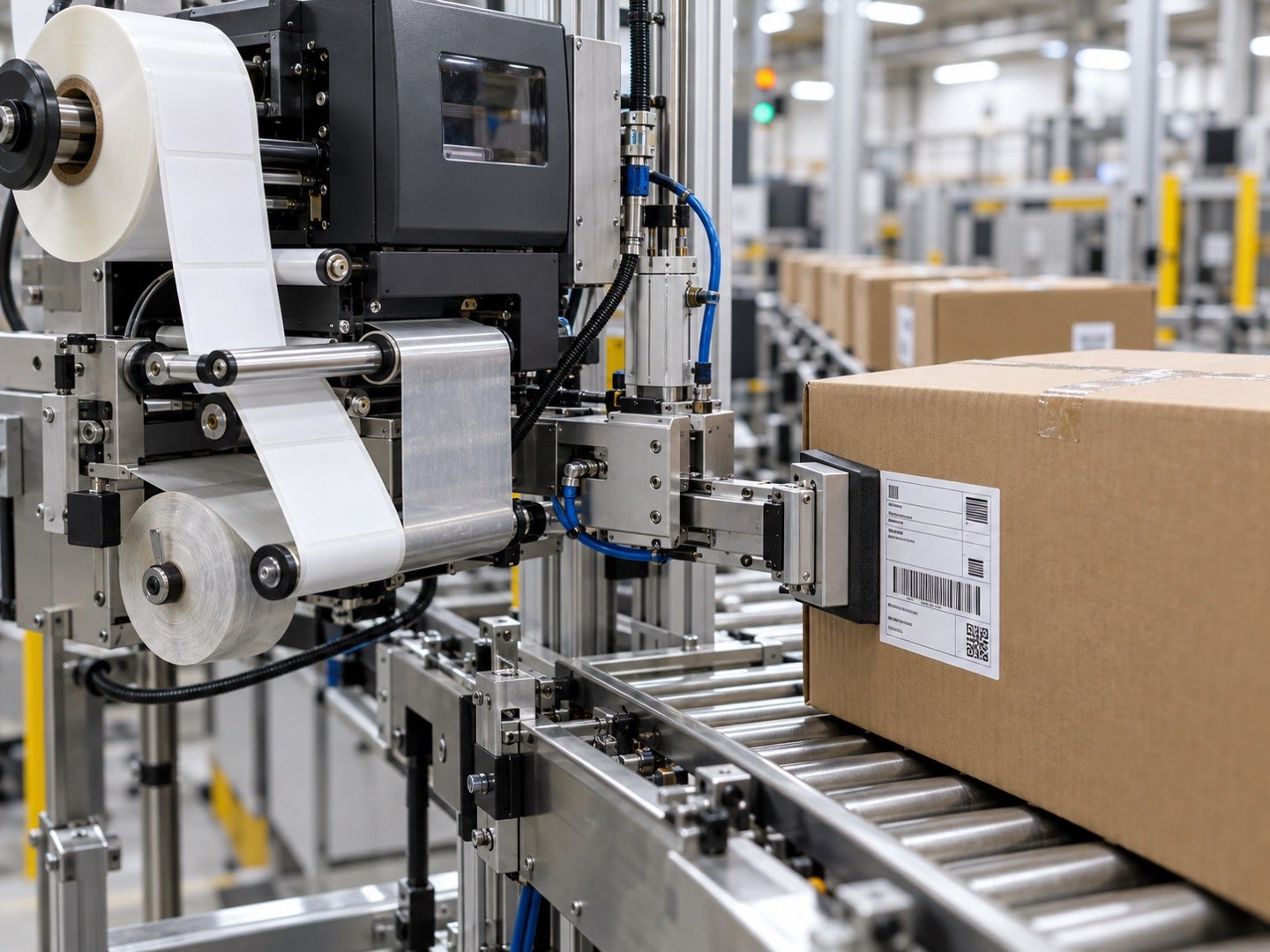
Print-and-apply labeler with a tamp applicator pressing a barcode shipping label onto the side of a corrugated case on roller conveyor (fictional company demonstration)
Station 05 · Label

A label on every case, read before it leaves.

The label prints from your WMS data at the moment the case arrives, not from a stack printed at shift start. A scanner grades every barcode downstream. A bad read goes to the reject lane, not onto the trailer.

  • 30 labels/min, tamp or tamp-blow
  • Placement held to ±1/16 in
  • One print engine change in under 10 min

03 · Projects

Two lines, measured before and after.

Both projects are illustrative. The clients are unnamed and every figure is invented for this demonstration.

Showing 2 of 2 illustrative projects

Illustrative project · fictionalFood & beverage

Frozen entrées, hand-packed on two lines

A frozen-food plant in central Pennsylvania, shipping to regional grocery DCs.

Two lines were erected and packed by hand. Halvard added erectors, top-load packers and sealers on both, feeding one checkweigher and one wrapper. Cut over during two weekend shutdowns.

Operators per shift
8 → 2
Cases/min per line
15 → 22
Changeover
35 → 7 min

Illustrative project · fictional3PL · Pharma

Pack-out for over-the-counter pharma

A Mid-Atlantic 3PL packing OTC pharma and consumer health for three brand owners.

Cases were labeled by hand from printed batches and wrapped on a semi-automatic wrapper. Halvard added checkweighing, print-and-apply with scan verification, and a turntable wrapper with pre-stretch.

Chargebacks per quarter
41 → 2
Labels, all scan-verified
28/min
Film per pallet
410 → 265 g

Find your line by function, machine or industry.

By function

Start from the job that is still done by hand.

By machine

Every machine we place, rated above line rate.

By industry

Same six stations, set up for your product.

  • Food & beverageWashdown frames, 15–30 cases/min
  • GroceryStore-ready cases, checkweighed
  • ParcelShip-ready cartons, carrier labels
  • ApparelPolybagged units into ship cartons
  • 3PLMulti-client pack-out, recipe changeovers
  • PharmaWeight-checked, scan-verified cases

04 · Process and service

From line study to the first wrapped pallet.

  1. Weeks 1–2

    Line study

    We film the current line, measure case sizes and rates, and find the station that sets the pace.

  2. Weeks 3–6

    Layout and fixed quote

    A scaled layout on your floor plan and one fixed price, with every machine rated above line rate.

  3. Weeks 7–20

    Build and FAT

    The line is built and run in Lancaster with your product and your cases before it ships.

  4. Weeks 21–22

    Install and SAT

    Weekend cutovers where we can. Your operators train on the running line, not a slide deck.

  5. After start-up

    Service

    The same engineers who built it take the calls. Spare-parts kits ship with the line.

Service runs out of the building that built the line.

Every Halvard line carries a parts list, the PLC program and the electrical drawings, kept current in our shop. When it stops, you call people who have seen it run.

Service line, 24/7
(717) 555-0163
Parts
In stock for every line we’ve built. Ordered by 3 pm ET, shipped the same day.
Remote
Secure PLC and HMI access. Most calls close without a truck.
On site
Technicians from Lancaster County, within 4 hours across most of PA, MD, DE and NJ.

05 · Project inquiry

Tell us about the end of your line.

Product, case sizes, the rate you need and the floor space you have. An engineer replies within one business day with questions, not a brochure.

Demonstration form. Nothing you enter is sent or stored. Submitting opens a preview of what the team would receive.

Projects
projects@halvard.example
Phone
(717) 555-0148
Shop
Lancaster County, Pennsylvania

Demonstration · not sent

Inquiry preview

This demonstration doesn't send anything. Halvard Packaging Automation is a fictional company.